Twenty years ago, being “digitally literate” meant knowing your way around email, spreadsheets, and presentation software. Those skills went from nice to have to non-negotiable in almost every job.
Today, the same shift is happening again, this time around artificial intelligence (AI).
AI Has Already Entered the Workplace
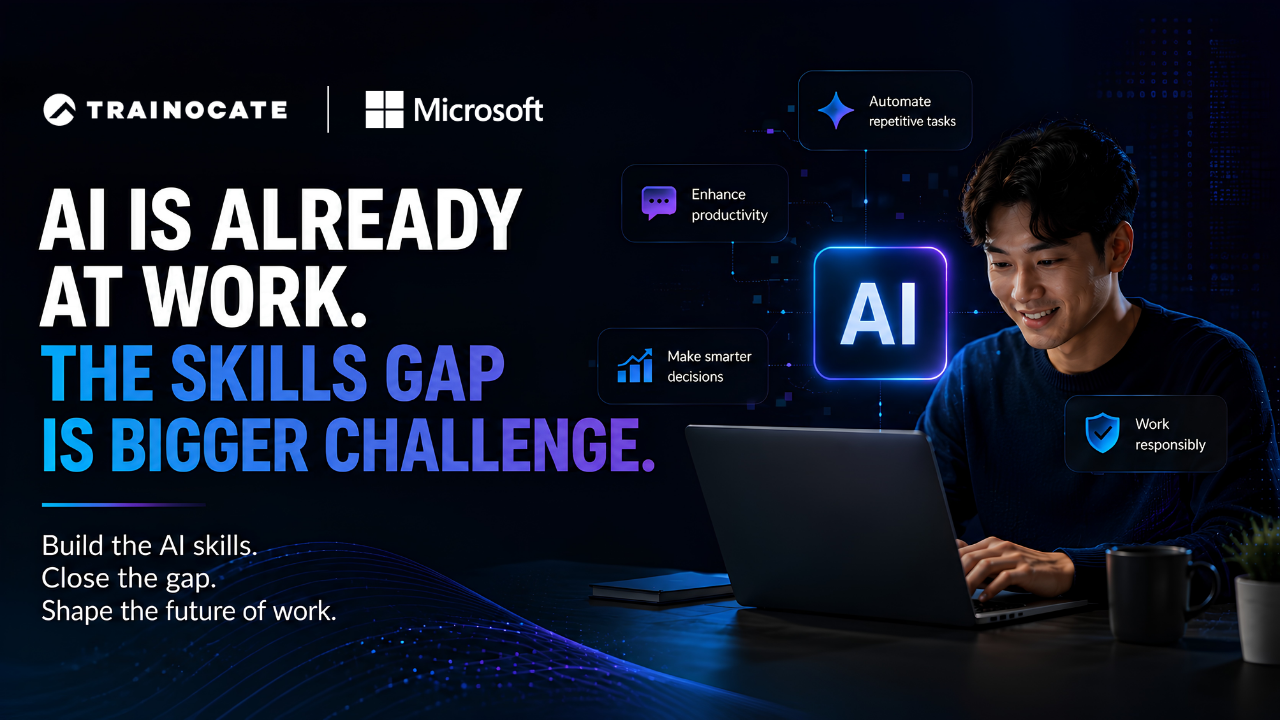
AI is no longer an emerging trend. It is a daily work habit. Professionals are using it to draft emails, summarise meetings, analyse data, and automate repetitive tasks. The real question for employers is not whether their people have access to AI anymore. It is whether those people know how to use it effectively, responsibly, and confidently.
The Numbers Behind the Shift
Microsoft’s 2025 Work Trend Index puts hard data behind this trend:
That last statistic is the one that should catch every leader’s attention.
It means leadership is racing ahead of employees on AI readiness, while most organizations still have not built the strategies, policies, and training needed to close the gap and put that readiness to work.
Malaysia’s AI Skills Gap, By the Numbers
The global picture is playing out just as sharply at home, and in some ways more so. Microsoft’s own 2025 Work Trend Index for Malaysia found that:
According to National AI Office (NAIO) head Sam Majid, Malaysia currently has about 3,000 AI professionals but needs 30,000 to support its AI ambitions. Without closing this gap, he warned, Malaysia risks remaining an AI consumer rather than becoming an AI producer.
The pressure is not limited to AI specialists. TalentCorp estimates that AI and digitalization could affect around 620,000 jobs, roughly 18% of Malaysia’s workforce, over the next five years, as roles are reshaped rather than simply replaced.
MDEC’s 2025 Talent Pulse report found that 63% of Malaysian companies are struggling to hire mid to senior level AI professionals specifically, while AI job postings in Malaysia have grown 38% year on year since 2023.
Put simply, the technology is arriving in Malaysia faster than the workforce that can use it.
AI Skills Are Needed Across Every Business Function
AI is no longer just for technical roles. Marketing, HR, finance, and business teams are using AI to create content, analyse data, automate workflows, and support decision-making. Every department needs the skills to use AI responsibly.
From Individual Experimentation to Organizational Strategy
Microsoft’s research points to a new phase of AI adoption, one where success depends less on access to AI tools and more on capability to use them well. Instead of leaving AI adoption to individual trial and error, organizations that invest in structured learning build a shared foundation across teams.
That foundation drives productivity gains while supporting good governance and responsible AI practices.
Closing the Skills Gap: Trainocate Malaysia’s AI Skills for Everyone Campaign
To help organizations close this gap, Trainocate Malaysia launched its Microsoft AI Skills for Everyone campaign, giving professionals and organizations a structured path to build practical AI capabilities through Microsoft’s official learning pathways and globally recognized certifications.
This work builds on Trainocate Malaysia’s recognition as Microsoft Malaysia’s Training Partner of the Year 2024, an award earned specifically for outperforming targets in Data and AI training delivery across the country, following on from being named Microsoft Malaysia Learning Partner of the Year
Whether someone is exploring AI for the first time, aiming to boost productivity in their current role, or building specialized technical expertise, the campaign offers learning tracks suited to different career stages and business needs, for instance:

Participants can build skills in AI fundamentals, responsible AI, Microsoft Copilot, prompt engineering, AI solution development, role-based AI applications, and attain Microsoft certifications.
Microsoft’s official learning pathways provide a structured approach to AI upskilling and long-term digital transformation.
You might also like: