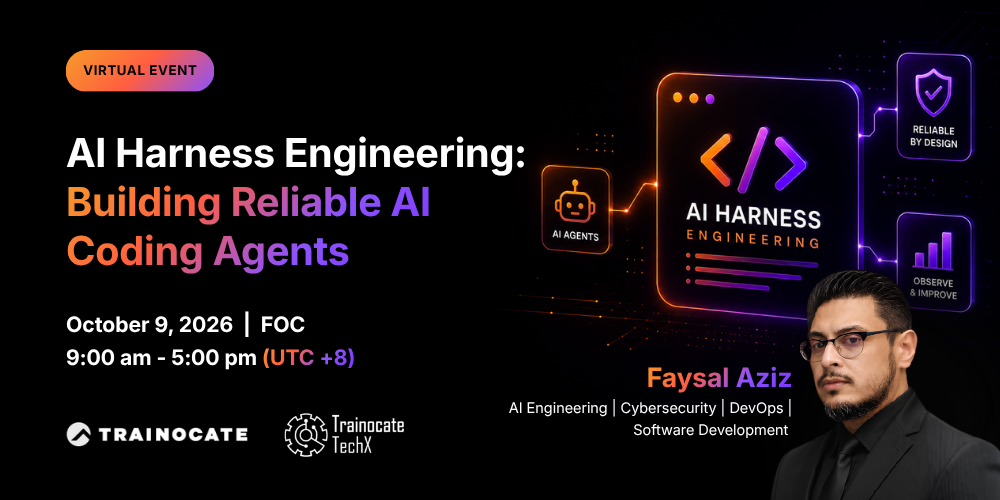
AI Harness Engineering: Building Reliable AI Coding Agents
Friday, 9 October 2026 | 9:00 AM – 5:00 PM (UTC +8) | Live Virtual (VILT)
Overview:
AI coding agents are becoming increasingly capable of inspecting repositories, modifying files, executing commands, running tests and completing substantial software engineering tasks. But reliable AI-assisted development requires more than simply using a capable AI model.
Poor instructions, incomplete context, excessive permissions and weak verification can lead to inconsistent or unsafe results. Harness Engineering addresses this challenge by focusing on the environment surrounding an AI coding agent, including how tasks are assigned, what information and tools the agent can access, how its actions are controlled and how its work is verified.
Join this free one-day virtual event to explore the foundations of Harness Engineering and discover how structured instructions, tools, permissions, repository knowledge, testing and human oversight can help create more dependable AI coding workflows.
Through practical, industry-relevant guidance, participants will gain a clearer understanding of how to build an environment where AI coding agents can operate more reliably and effectively.
Objectives:
By the end of this event, participants will be able to:
- Understand Harness Engineering and its role in AI-assisted software development
- Distinguish Harness Engineering from prompt engineering and context engineering
- Identify the essential components of an AI coding-agent harness
- Understand how instructions, tools, permissions and verification guide AI agents
- Recognise common harness design and repository-readiness challenges
- Understand how to structure a controlled workflow for agent-assisted software development
Key Topics Covered
1. Harness Engineering Fundamentals
- Definition and purpose of Harness Engineering
- Evolution from prompt engineering
- Understanding the model, agent, harness and environment
- Benefits and current limitations
2. Essential Harness Components
- Task instructions and acceptance criteria
- Context and repository knowledge
- Tools and execution environments
- State and progress tracking
- Permissions and operational boundaries
- Observability and activity records
3. Agent Guidance and Control
- Repository instruction files
- Coding and architectural standards
- Tool-use guidance Human approval checkpoints
- Escalation conditions
4. Feedback and Verification
- Build and compilation checks
- Formatting and linting
- Automated testing
- Security and policy checks
- Completion evidence
- Human review
5. Repository Readiness
- Predictable project structures
- Current and accessible documentation
- Discoverable development commands
- Clear architectural boundaries
- Reliable testing workflows
- Removing stale instructions and artefacts
6. Basic Harness Workflow
- Task intake
- Context discovery Planning
- Controlled implementation
- Automated validation
- Correction and revalidation
- Completion reporting
7. Common Harness Failures
- Ambiguous instructions
- Missing or excessive context
- Unrestricted tool access
- Weak verification
- Stale repository documentation
- Unsupported completion claims
8. Starter Harness Design
- Defining the supported task
- Selecting the minimum required context
- Selecting permitted tools Establishing safety boundaries
- Defining verification requirements
- Establishing human oversight
Who Should Attend?
This event is suitable for:
- Software Developers and Software Engineers
- Technical Leads and Engineering Managers
- DevOps and DevSecOps Professionals
- Solution and Software Architects
- AI Engineers and Developers
- Technology Professionals exploring AI-assisted software development
- Teams looking to introduce AI coding agents into development workflows
Prerequisites
Participants should have:
- A general understanding of software development
- Basic familiarity with source-code repositories
- Awareness of generative AI and AI coding assistants
- Basic knowledge of testing and command-line operations
No machine-learning development experience is required.
Speaker:

Faysal Aziz
AI Engineering | Cybersecurity | DevOps | Software Development
Faysal Aziz is a technology professional with over 35 years of industry experience spanning software engineering, systems architecture, cloud platforms, cybersecurity, automation and artificial intelligence.
His recent work focuses strongly on generative AI, agentic AI systems, enterprise AI adoption, workflow automation, developer productivity and digital transformation. His approach emphasises practical implementation and industry-relevant learning, helping professionals understand how emerging technologies can be applied in real operational environments.
Faysal brings extensive hands-on experience across AI integration and development, software development, DevOps and DevSecOps, cybersecurity, system automation, solution design and digital transformation.