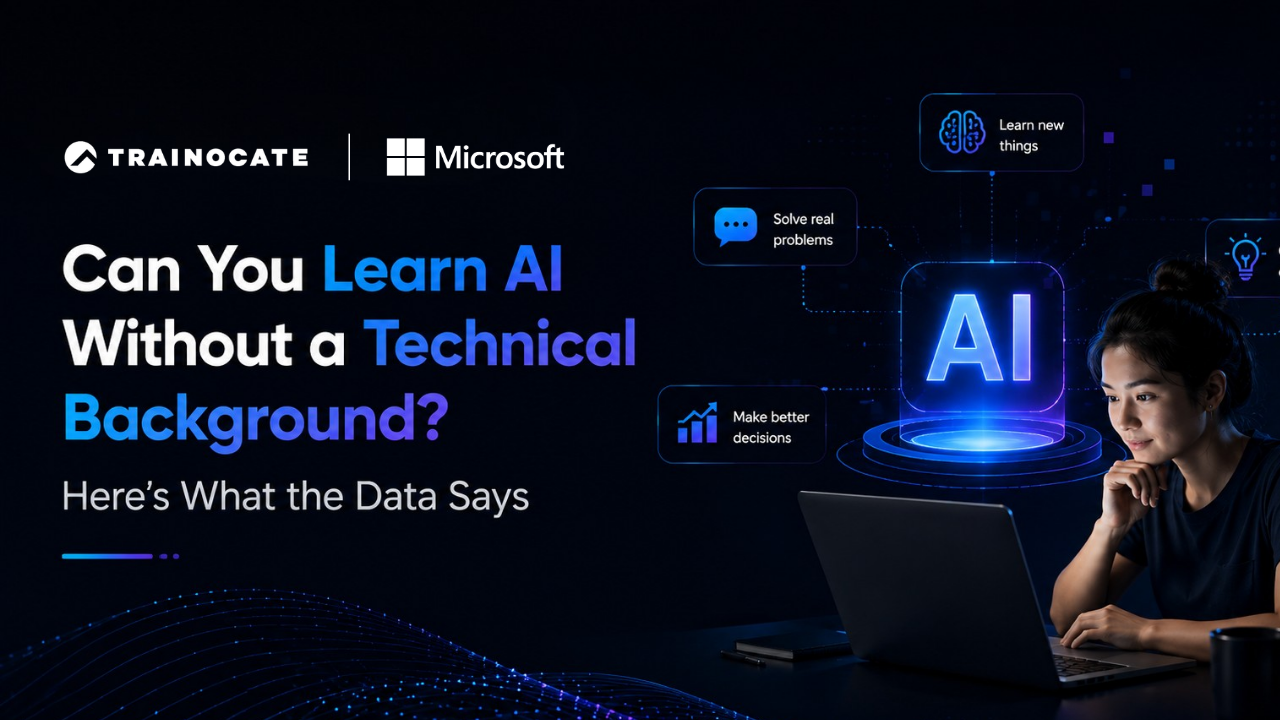
One of the most common myths about artificial intelligence (AI) is that it’s reserved for software developers, data scientists, or AI engineers. Building AI systems does require technical expertise, but using AI at work is an entirely different skill set, and one far more people can pick up than they realise.
AI Skills Are No Longer Just a Tech-Team Thing
AI has already spread well beyond engineering departments. It’s now part of daily work in marketing, finance, human resources, customer service, sales, and project management. Instead of building AI models, most professionals are simply using AI to write, research, analyse information, summarise meetings, and automate routine tasks.
The Data: Non-Technical Professionals Are Leading the Curve
Microsoft’s 2024 Work Trend Index backs this up with hard numbers:
The takeaway isn’t that everyone needs to become an AI engineer. It’s that AI fluency is becoming a baseline expectation across almost every profession, and the data backs that up specifically for the roles that were never expected to need it.
The Same Shift, Playing Out Across Malaysia
This isn’t just a global trend. Microsoft has committed to equipping 800,000 Malaysians with AI skills by the end of 2025, recognising that AI literacy is becoming essential across government, education, businesses and communities, not just among technology professionals. This direction aligns with Malaysia’s broader Ekonomi MADANI agenda, which emphasises developing a high-skilled workforce, creating high-value employment and equipping Malaysians with the capabilities needed to support a knowledge, technology and innovation-driven economy.
The pattern shows up clearly in hiring data too. LinkedIn’s own job market analysis has found that a large and growing share of AI-related job postings are now for non-technical roles such as marketing, sales, HR, and operations, where AI literacy is the differentiator rather than deep coding ability. In other words, the fastest-growing AI job market isn’t for people who can build the models. It’s for people who know how to use them well inside a business function they already understand.
There’s a warning sign here too. Randstad’s 2026 Market Outlook and Salary Guide for Malaysia found that 13% of the local workforce is hindered by corporate restrictions on AI use, creating a skills gap that could encourage employees to seek organisations offering greater exposure to AI-driven innovation.
The labour market is already responding to the growing role of AI. According to PwC’s 2026 Global AI Jobs Barometer, the share of job postings in Malaysia requiring AI skills more than doubled from 1.9% in 2024 to 4.0% in 2025, reflecting the increasing demand for AI capabilities in the workforce. However, PwC highlights that a workforce readiness gap remains, warning that without timely action to strengthen skills and capabilities, Malaysia risks missing critical economic and innovation opportunities. As AI becomes more deeply integrated into everyday work, technical proficiency alone will not be enough. Human capabilities such as judgement, creativity and empathy are expected to become increasingly important sources of value and differentiation alongside AI skills. The report also highlights the growing economic value of these capabilities, with AI-skilled workers commanding a wage premium, further reinforcing why developing AI proficiency is becoming increasingly valuable for both organisations and professionals.
Where to Start: Apply AI to the Work You Already Do
For most professionals, learning AI isn’t about mastering algorithms. It’s about understanding how AI can support the work they’re already doing.
Some real-world examples:



None of these require programming knowledge. They require business knowledge paired with the confidence to use the right tool.
Different Roles Need Different AI Skills
Microsoft’s own guidance on workforce skilling, Empower your teams to grow their AI skills and boost adoption, lays this out as a five-level framework rather than a single track. Understanding AI is aimed at leaders, managers, and professionals who want foundational knowledge of generative and responsible AI. Applying AI is for those incorporating it into their day-to-day role. Building AI suits power users working with low-code or no-code tools. Training and maintaining AI, and deep specialisation in AI, are reserved for engineers and technical teams working directly on AI models. A marketing manager and a machine learning engineer are on entirely different rungs of that ladder, and that’s by design.
Training Is Playing Catch-Up with Adoption
Employees are already ahead of their organisations here. In its Microsoft 365 blog post Workers Worldwide Are Embracing AI, Especially in Small and Medium-Size Businesses, Microsoft notes that employees are incorporating AI into daily work faster than most companies are rolling out formal training. Structured learning helps close that gap ensuring AI is used effectively, securely, and responsibly as adoption keeps growing.
You might also like: